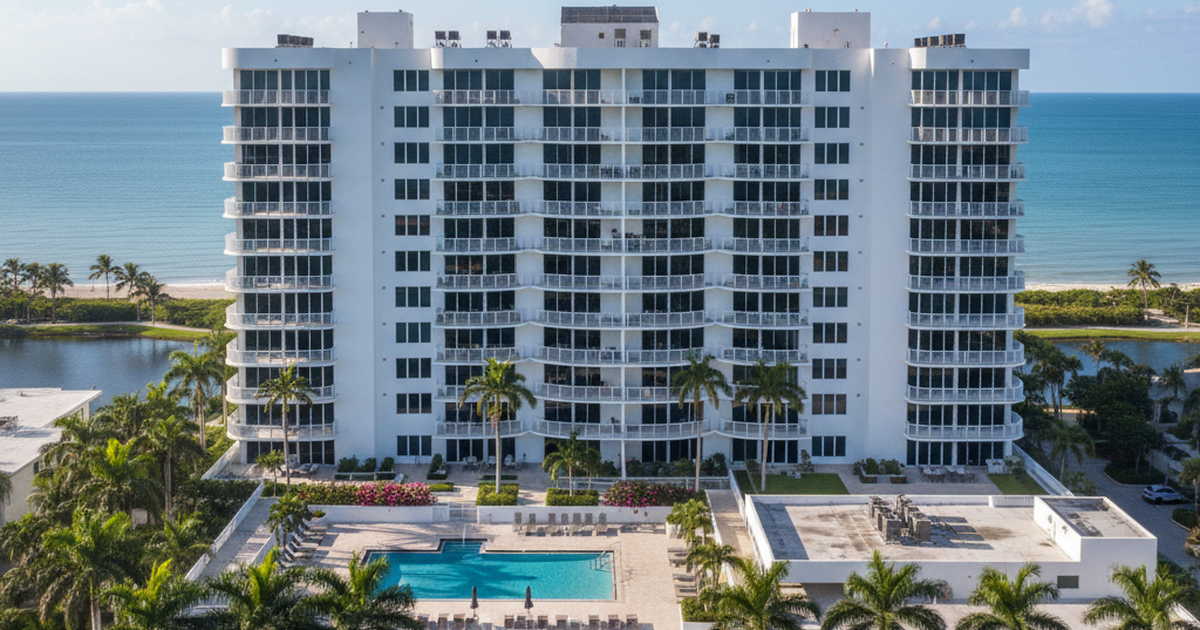
Florida's condominium market is moving through a very specific moment in 2026. Buyer activity is improving, condo and townhouse pending sales are rising, and affordability is bringing some buyers back to the category. At the same time, boards, sellers, property managers, and listing agents are operating under a much more serious inspection and reserve environment than they were a few years ago.
That combination matters. A condo listing is no longer only a question of location, amenities, view, and price. Buyers and lenders are paying closer attention to building age, reserve planning, exterior condition, insurance pressure, roof history, concrete repairs, balcony maintenance, waterproofing, and whether the association has handled its required documentation. For older Florida condominium buildings, especially three-story and higher properties, visual records are becoming part of the trust layer around the transaction.
Drone documentation does not replace a licensed engineer, architect, milestone inspection, reserve study, or legal compliance process. That distinction is important. What it can do is support those professionals with a clearer exterior record: roofs, facades, balconies, elevations, drainage areas, access limitations, post-storm conditions, and visible changes over time. For condo boards and real estate professionals, that kind of documentation can help reduce confusion before it becomes expensive.
Why This Topic Matters Now
Florida's current condo conversation is being shaped by two forces at once: market activity and building documentation.
On the market side, Florida Realtors reported that statewide condo and townhouse closed sales increased 6.9% year over year in April 2026, while new pending sales increased 14.7%. The statewide median condo-townhouse sale price was $315,000, unchanged from April 2025, and months' supply of inventory stood at 8.9 months. Florida Realtors also noted that the median time from listing to contract for condo and townhouse sales reached 60 days in April 2026, compared with 56 days one year earlier. [1]
Those numbers point to a market with renewed activity, but not a frictionless one. Buyers may be interested, but they are still taking time to evaluate. Condo transactions often carry more due diligence than single-family homes because the buyer is evaluating both the unit and the association behind it.
On the compliance side, Florida has formal requirements for milestone inspections and Structural Integrity Reserve Studies, commonly referred to as SIRS. The Florida Department of Business and Professional Regulation explains that milestone inspections apply to residential condominium and cooperative buildings, including mixed-ownership buildings, that are three or more habitable stories in height. DBPR states that these buildings must receive a milestone inspection at 30 years of age and every 10 years after that, or at 25 years and every 10 years after that when the local enforcement agency has determined that local circumstances require the earlier threshold. [2]
The takeaway for boards and agents is straightforward: documentation now affects confidence. A clean listing media package may get attention, but serious buyers also want to understand the building context.
What Milestone Inspections and SIRS Actually Cover
Florida Statute 553.899 defines a milestone inspection as a structural inspection of a building, including load-bearing elements and primary structural members or systems, performed to determine whether substantial structural deterioration exists. The statute describes a two-phase process. Phase 1 is a visual examination by a licensed architect or engineer. If no signs of substantial structural deterioration are found, Phase 2 is not required. If substantial deterioration is identified, Phase 2 involves a more detailed inspection. [3]
That legal structure is the reason drone documentation must be positioned correctly. A drone operator should not claim to "perform" the milestone inspection unless the service is being conducted under the appropriate licensed professional scope. The useful role is different: capturing high-resolution exterior imagery that helps the professional team, board, manager, or listing team understand and communicate visible building conditions.
SIRS is related but not identical. Florida Statute 718.112 requires residential condominium associations to complete a structural integrity reserve study at least every 10 years after creation for each condominium building that is three habitable stories or higher. The statute lists several building items that must be studied, including the roof, structure, fireproofing and fire protection systems, plumbing, electrical systems, waterproofing and exterior painting, windows, exterior doors, and other items with deferred maintenance or replacement cost above the statutory threshold. [4]
DBPR also explains that if an association is required to complete a milestone inspection on or before December 31, 2026, it may complete the SIRS simultaneously with that milestone inspection, but the SIRS may not be completed after December 31, 2026. [2]
For boards, this creates a practical coordination problem. They need the right licensed professionals, the right schedule, the right access, the right records, and a way to communicate building condition without relying on scattered photos, old PDFs, or memory.
Where Drone Documentation Fits
Drone documentation is most useful when it is treated as a visual record, not as a substitute for engineering judgment.
For a condominium building, a professional drone capture can document roof surfaces, visible ponding areas, parapets, facade elevations, balcony stacks, exterior corridors, upper-level details, pool decks, parking structures, drainage areas, and site context. Depending on the aircraft, camera, airspace, access, and safety plan, the deliverables may include organized photo sets, overview video, orthomosaic-style visuals, inspection grids, or repeatable progress comparisons.
The advantage is consistency. Ground photos tend to overrepresent what is easy to reach. A manager may have dozens of phone photos from one corner of the property and almost nothing from the roof edge, upper facade, or rear elevation. A planned drone capture can document the full exterior more evenly, which helps create a baseline before repairs, insurance reviews, listing preparation, or annual maintenance planning.
That baseline becomes more valuable over time. If a board captures the building before hurricane season, after a major storm, before a roof project, after concrete repairs, and again during the next reserve planning cycle, the association has a clearer timeline. The same idea helps agents. A listing team marketing a condo unit inside a building with known documentation practices can explain the due diligence context more confidently than an agent who has only interior photos and amenity shots.
The most professional use is collaborative. The board or property manager coordinates with the engineer, architect, roofer, reserve specialist, insurance team, or restoration contractor. The drone media provider captures the exterior in a structured way. The licensed professional interprets what the imagery means. That keeps the roles clean and the record useful.
What Agents Should Understand Before Marketing Older Condo Units
Agents do not need to become building inspectors, but they do need to understand how buyer expectations have changed.
Florida Realtors' April 2026 condo-townhouse data shows demand improving, but it also shows condo properties taking longer to go under contract than a year earlier. [1] That extra time can be caused by many factors: pricing, financing, insurance, association documents, reserves, building age, assessments, or buyer uncertainty. Visual documentation will not solve every objection, but it can reduce one category of uncertainty: "What does the building actually look like outside the unit?"
For listing agents, that matters because many condo listings still lean heavily on interior photos, balcony views, lobby images, pool amenities, and lifestyle shots. Those assets remain important, but they do not answer practical building-condition questions. A stronger listing media package for an older condominium may include:
Professional HDR interior and amenity photography
Exterior building photos from ground level
Drone aerials showing site context, parking, roof layout, waterfront or neighborhood position
Non-diagnostic visual documentation of visible exterior areas
Clear separation between marketing media and inspection records
A note that buyers should review association documents, inspection reports, reserve information, and professional reports where applicable
That last point is essential. Marketing should not overstate what media proves. A drone photo can show visible exterior conditions on the day of capture. It cannot certify structural safety, remaining useful life, waterproofing performance, reserve adequacy, or legal compliance. Clean boundaries build trust.
FAA Compliance Still Applies
Condo documentation flights also require aviation discipline. The FAA explains that Part 107 covers commercial small unmanned aircraft operations under 55 pounds and includes operating limits such as daylight or civil twilight operations with appropriate lighting, minimum weather visibility of three miles, a general maximum altitude of 400 feet above ground level or higher when the aircraft remains within 400 feet of a structure, and a maximum speed of 100 mph. [5]
The FAA also states that some operations require waivers, including operations beyond visual line of sight, certain operations over people, operations over moving vehicles, and other activities outside standard Part 107 limits. [6]
That matters for condo properties because dense residential buildings often have people, vehicles, roads, balconies, adjacent structures, controlled airspace, and privacy considerations. A professional provider should plan the flight around resident activity, airspace, launch and recovery areas, visual line of sight, wind, sun angle, safety observers when needed, and how to avoid capturing private interiors or identifiable residents.
For boards and property managers, this is not a minor detail. The cheapest drone option is not always the best documentation option. The right provider should be able to explain what they can capture, what they cannot capture, how the flight will be conducted safely, and how media will be organized after delivery.
A Practical Documentation Plan for Florida Condo Boards
For associations that want better records without overcomplicating the process, a simple annual or event-based plan is usually enough.
First, capture a baseline exterior package. This should include roof overviews, facade elevations, amenity areas, drainage and retention areas when applicable, parking and access points, and any exterior components the association is responsible for maintaining. The goal is not to diagnose every issue. The goal is to create a complete visual reference.
Second, coordinate documentation around known events. If the building has a milestone inspection, SIRS, roof project, concrete repair, exterior painting project, hurricane season preparation, or post-storm review, schedule drone capture before and after the relevant work. That creates a cleaner record than trying to reconstruct conditions months later.
Third, keep the files organized by date, building elevation, location, and purpose. A folder named "Drone Photos" is not enough. Boards should be able to find the east elevation, roof overview, pool deck, parking structure, or post-storm set quickly.
Fourth, preserve the professional boundaries. Drone documentation can be shared with engineers, architects, reserve specialists, insurance professionals, roofers, restoration contractors, and legal counsel. Interpretation should come from the appropriate licensed or qualified professional.
Finally, use the media thoughtfully in real estate marketing. A few polished aerials can help buyers understand location and lifestyle. A separate documentation set can support transparency during due diligence. Mixing the two carelessly can create confusion, so agents should keep marketing assets and inspection-support assets clearly labeled.
What Property HDR Can Help With
Property HDR is positioned for the visual documentation side of this workflow: professional drone capture, exterior media, real estate photography, construction-style progress records, and organized visual deliverables for Florida properties.
For condo boards, property managers, and listing teams, the strongest use case is a clean, repeatable visual baseline. That may support pre-storm documentation, post-storm records, marketing packages, exterior condition references, roof documentation, or coordination with licensed professionals during inspection and reserve planning cycles.
The value is not in claiming that photos solve compliance. They do not. The value is in giving decision-makers a better record so fewer conversations depend on memory, scattered phone photos, or incomplete views from the ground.
Florida's condo market is active again, but it is also more documentation-sensitive. Boards that maintain clear records and agents who understand the difference between marketing claims and useful visual evidence will have an advantage. Buyers are asking better questions. The media package should be ready for that.
If your condominium building, association, or listing team needs professional aerial documentation, exterior visuals, or a complete listing media package, Property HDR can help you plan a clean capture and deliver organized media for review.
Request a Quote.
Sources
[1] Florida Realtors. (2026, May 15). April 2026 Florida Townhouses and Condos monthly market summary. https://www.floridarealtors.org/sites/default/files/2026-05/April-2026-Fla-condo-summary.pdf
[2] Florida Department of Business and Professional Regulation. (2026). Condominium Information and Resources: Inspections. https://condos.myfloridalicense.com/inspections
[3] Florida Legislature. (2025). Florida Statute 553.899, Mandatory structural inspections for condominium and cooperative buildings. https://www.leg.state.fl.us/Statutes/index.cfm?App_mode=Display_Statute&Search_String=&URL=0500-0599%2F0553%2FSections%2F0553.899.html
[4] Florida Legislature. (2025). Florida Statute 718.112, Structural integrity reserve study requirements. https://www.leg.state.fl.us/Statutes/index.cfm?App_mode=Display_Statute&URL=0700-0799%2F0718%2FSections%2F0718.112.html
[5] Federal Aviation Administration. (2026). Small Unmanned Aircraft Systems (UAS) Regulations (Part 107). https://www.faa.gov/newsroom/small-unmanned-aircraft-systems-uas-regulations-part-107
[6] Federal Aviation Administration. (2026). Part 107 Waivers. https://www.faa.gov/uas/commercial_operators/part_107_waivers